
Murray Hill Orthodontics
Contact
Hours
<ul id=”hours” style=”transition: height .3s ease;”>
<li>Monday: 9:00am – 9:00pm</li>
<li>Tuesday: 9:00am – 6:00pm</li>
<li>Wednesday: 9:00am – 9:00pm</li>
<li>Thursday: 9:00am – 9:00pm</li>
<li>Friday: 9:00am – 5:00pm</li>
</ul>

Murray Hill Orthodontics, located in the heart of New York, New York, is dedicated to providing exceptional orthodontic care in a warm and welcoming environment. Led by a team of experienced orthodontists, our practice combines personalized treatment plans with state-of-the-art technology to help patients achieve beautiful, healthy smiles. Whether you’re interested in traditional braces or clear aligners, Murray Hill Orthodontics offers a comprehensive range of orthodontic services to suit your needs.
Orthodontic Services
Traditional Braces
- Metal Braces: Time-tested orthodontic solution for correcting misaligned teeth and bite issues.
- Ceramic Braces: Clear or tooth-colored brackets for a more discreet orthodontic treatment option.
Clear Aligner Therapy
- Invisalign: Removable clear aligners for a virtually invisible way to straighten teeth without traditional braces.
- ClearCorrect: Transparent aligners that gradually shift teeth into alignment for a more aesthetically pleasing smile.
Comprehensive Orthodontic Care
Initial Consultation
- Orthodontic Evaluation: Thorough assessment to determine the most suitable treatment plan for your individual needs and goals.
- Customized Treatment Plan: Tailored orthodontic approach designed to achieve optimal results while considering your lifestyle and preferences.
Orthodontic Treatment
- Braces Adjustment: Regular visits to ensure braces or aligners are properly adjusted for consistent progress and comfort.
- Interceptive Orthodontics: Early intervention to address orthodontic issues in children and prevent more serious problems from developing.
Patient Experience
Comfortable Environment
- Modern Facility: State-of-the-art office equipped with advanced orthodontic technology for efficient and effective treatment.
- Relaxing Atmosphere: Comfortable and inviting environment to help patients feel at ease during their orthodontic appointments.
Personalized Care
- Individualized Attention: Dedicated orthodontic team committed to providing personalized care and addressing your specific concerns throughout your treatment journey.
- Open Communication: Transparent communication about your treatment plan, progress, and any adjustments needed to ensure the best possible outcome.

Ankyloglossia
Ankyloglossia, commonly known as tongue-tie, is a congenital condition characterized by an unusually short, thick, or tight band of tissue (lingual frenulum) that tethers the bottom of the tongue's tip to the floor of the mouth. This restriction of tongue movement can affect various aspects of oral function and may lead to complications such as breastfeeding difficulties, speech impediments, or oral hygiene issues.
Here are some key points about ankyloglossia:
- Causes: Ankyloglossia occurs during fetal development when the lingual frenulum fails to fully recede, resulting in a shortened or abnormally positioned frenulum. The exact cause of ankyloglossia is not always clear but may be influenced by genetic factors or abnormal tissue development in the mouth.
- Symptoms: The symptoms of ankyloglossia can vary depending on the severity of tongue restriction and the individual's age. In infants, common symptoms may include difficulty latching onto the breast during breastfeeding, poor weight gain, or maternal nipple pain and trauma. In older children or adults, ankyloglossia may contribute to speech difficulties, such as difficulty pronouncing certain sounds (particularly those involving the tongue's movement), limited tongue mobility, or persistent drooling.
- Diagnosis: Diagnosis of ankyloglossia is typically based on a physical examination of the tongue's appearance and range of motion. Healthcare providers may assess the length and mobility of the lingual frenulum and evaluate for signs of restriction or tension during tongue movement. In some cases, additional diagnostic tests, such as a speech evaluation or breastfeeding assessment, may be recommended to assess the functional impact of ankyloglossia.
- Treatment: Treatment of ankyloglossia depends on the severity of symptoms and the functional limitations caused by tongue restriction. In infants with breastfeeding difficulties, a procedure called frenotomy or frenulotomy may be performed to release the tight or thickened lingual frenulum, allowing for improved tongue mobility and breastfeeding success. In older children or adults experiencing speech or oral function issues, a more extensive procedure known as frenuloplasty or frenectomy may be recommended to surgically release the lingual frenulum.
- Prognosis: With appropriate treatment, the prognosis for ankyloglossia is generally favorable, particularly when intervention occurs early in infancy. Frenotomy or frenectomy procedures are usually safe and well-tolerated, with minimal risk of complications. Following treatment, individuals with ankyloglossia may experience improved breastfeeding outcomes, speech clarity, oral hygiene, and overall quality of life.
In summary, ankyloglossia is a congenital condition characterized by a shortened or restricted lingual frenulum, which can lead to various oral function difficulties such as breastfeeding problems in infants or speech impediments in older children and adults. Early diagnosis and appropriate intervention are essential for addressing the functional limitations associated with ankyloglossia and improving outcomes for affected individuals.
Inlays and Onlays
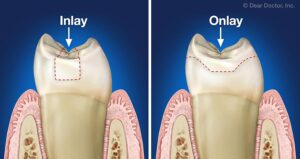
Dental inlays and onlays are types of restorations used to repair damaged or decayed teeth, providing strength and stability while also preserving as much natural tooth structure as possible. They are often considered more conservative alternatives to full dental crowns.
Here's an overview of dental inlays and onlays:
- Definition:
- Inlays: Inlays are custom-made restorations that fit into the prepared cavity within the center of a tooth, typically replacing the area between the cusps (the raised points on the chewing surface).
- Onlays: Onlays are similar to inlays but cover one or more cusps of the tooth, extending onto the chewing surface. They are sometimes referred to as "partial crowns" because they provide more coverage than inlays but less than full crowns.
- Materials:
- Dental inlays and onlays can be made from various materials, including porcelain, composite resin, or gold. Each material has its own advantages in terms of strength, durability, and aesthetics. Porcelain inlays and onlays are popular for their natural appearance and ability to blend seamlessly with the surrounding teeth.
- Procedure:
- The procedure for placing inlays and onlays typically involves two appointments:
- First Appointment: During the initial visit, the dentist prepares the tooth by removing any decay or damage and shaping the cavity to accommodate the restoration. Impressions or digital scans of the tooth are then taken, which are used to fabricate the custom-made inlay or onlay.
- Second Appointment: At the second visit, the dentist bonds the inlay or onlay to the prepared tooth using dental adhesive. The restoration is carefully adjusted and polished to ensure a comfortable fit and natural appearance.
- Advantages:
- Dental inlays and onlays offer several advantages compared to traditional dental fillings or crowns:
- Preservation of Tooth Structure: Inlays and onlays require less removal of healthy tooth structure compared to crowns, helping to preserve the integrity of the tooth.
- Strength and Durability: Inlays and onlays are durable restorations that provide long-lasting support and protection for the tooth.
- Aesthetics: Porcelain inlays and onlays can be custom-made to match the color and appearance of the natural teeth, providing a seamless and aesthetically pleasing result.
- Indications:
- Dental inlays and onlays are suitable for restoring teeth with moderate to severe decay, damage, or wear. They are often recommended for teeth that cannot be adequately repaired with a filling but do not require a full crown.
Overall, dental inlays and onlays are versatile restorative options that can help strengthen and protect damaged teeth while also enhancing their appearance. If you believe you may benefit from an inlay or onlay, consult with your dentist to discuss your options and determine the most appropriate treatment for your needs.